


Page 300 - 二十世纪及当代艺术
P. 300
艺术家简历  ARTIST BIOGRAPHIES


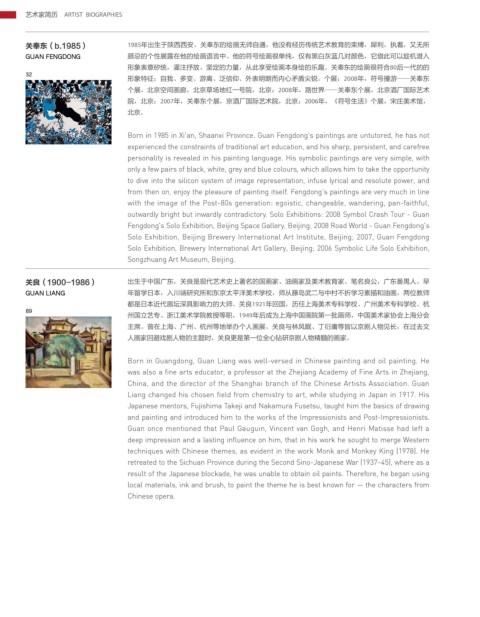
       关奉东(b.1985)               1985年出生于陕西西安。关奉东的绘画无师自通,他没有经历传统艺术教育的束缚,犀利,执着,又无所
       GUAN FENGDONG             顾忌的个性展露在他的绘画语言中。他的符号绘画很单纯,仅有黑白灰蓝几对颜色,它借此可以趁机潜入
                                 形象表意矽统,灌注抒放、坚定的力量,从此享受绘画本身绘的乐趣。关奉东的绘画很符合80后一代的的
       32
                                 形象特征:自我、多变、游离、泛信仰、外表明朗而内心矛盾尖锐。个展:2008年,符号撞游—关奉东
                                 个展,北京空间画廊,北京草场地红一号院,北京;2008年,路世界—关奉东个展,北京酒厂国际艺术
                                 院,北京;2007年,关奉东个展,京酒厂国际艺术院,北京;2006年,《符号生活》个展,宋庄美术馆,
                                 北京。

                                 Born in 1985 in Xi'an, Shaanxi Province. Guan Fengdong's paintings are untutored, he has not
                                 experienced the constraints of traditional art education, and his sharp, persistent, and carefree
                                 personality is revealed in his painting language. His symbolic paintings are very simple, with
                                 only a few pairs of black, white, grey and blue colours, which allows him to take the opportunity
                                 to dive into the silicon system of image representation, infuse lyrical and resolute power, and
                                 from then on, enjoy the pleasure of painting itself. Fengdong's paintings are very much in line
                                 with the image of the Post-80s generation: egoistic, changeable, wandering, pan-faithful,
                                 outwardly bright but inwardly contradictory. Solo Exhibitions: 2008 Symbol Crash Tour - Guan
                                 Fengdong's Solo Exhibition, Beijing Space Gallery, Beijing; 2008 Road World - Guan Fengdong's
                                 Solo Exhibition, Beijing Brewery International Art Institute, Beijing; 2007, Guan Fengdong
                                 Solo Exhibition, Brewery International Art Gallery, Beijing; 2006 Symbolic Life Solo Exhibition,
                                 Songzhuang Art Museum, Beijing.

       关良(1900-1986)             出生于中国广东,关良是现代艺术史上著名的国画家、油画家及美术教育家。笔名良公,广东番禺人。早
       GUAN LIANG                年留学日本,入川端研究所和东京太平洋美术学校,师从藤岛武二与中村不折学习素描和油画,两位教师
                                 都是日本近代画坛深具影响力的大师。关良1921年回国,历任上海美术专科学校、广州美术专科学校、杭
       89
                                 州国立艺专、浙江美术学院教授等职,1949年后成为上海中国画院第一批画师,中国美术家协会上海分会
                                 主席。曾在上海、广州、杭州等地举办个人画展。关良与林风眠、丁衍庸等皆以京剧人物见长,在过去文
                                 人画家回避戏剧人物的主题时,关良更是第一位全心钻研京剧人物精髓的画家。

                                 Born in Guangdong, Guan Liang was well-versed in Chinese painting and oil painting. He
                                 was also a fine arts educator, a professor at the Zhejiang Academy of Fine Arts in Zhejiang,
                                 China, and the director of the Shanghai branch of the Chinese Artists Association. Guan
                                 Liang changed his chosen field from chemistry to art, while studying in Japan in 1917. His
                                 Japanese mentors, Fujishima Takeji and Nakamura Fusetsu, taught him the basics of drawing
                                 and painting and introduced him to the works of the Impressionists and Post-Impressionists.
                                 Guan once mentioned that Paul Gauguin, Vincent van Gogh, and Henri Matisse had left a
                                 deep impression and a lasting influence on him, that in his work he sought to merge Western
                                 techniques with Chinese themes, as evident in the work Monk and Monkey King (1978). He
                                 retreated to the Sichuan Province during the Second Sino-Japanese War (1937–45), where as a
                                 result of the Japanese blockade, he was unable to obtain oil paints. Therefore, he began using
                                 local materials, ink and brush, to paint the theme he is best known for — the characters from
                                 Chinese opera.

